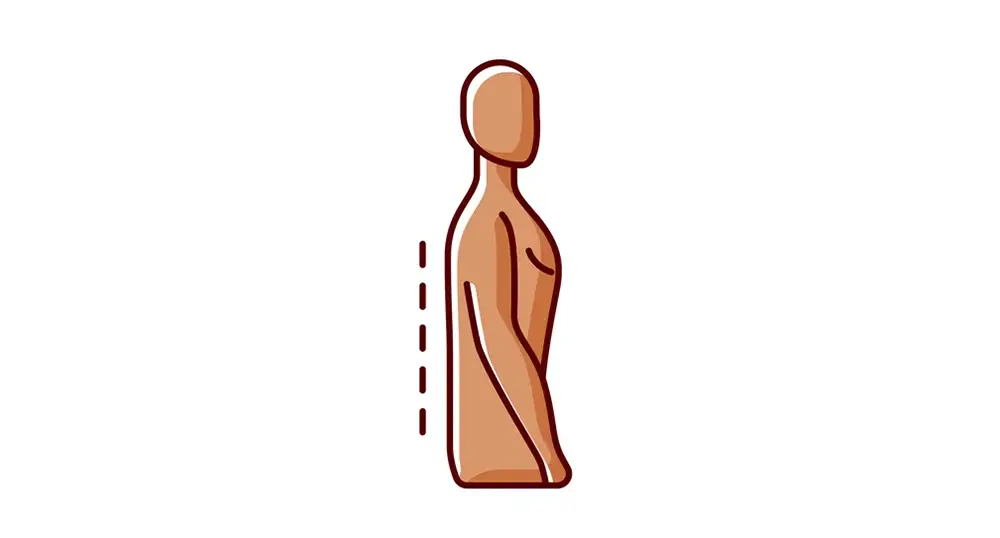





You should not have to “fight” your own body just to stand upright. If you notice you lean forward without meaning to, your low back looks unusually straight, or your back and hips feel tired after a short time on your feet, it is reasonable to ask: do I have flatback posture?
Sometimes this is a posture and muscle-control issue that improves with targeted therapy and ergonomic changes. Other times, it reflects a deeper alignment problem called flatback syndrome, where the spine’s curves no longer support your body efficiently. The difference matters, because it changes what treatment is most likely to help.
What Flatback Posture Means (and Why a “Straight Spine” Isn’t Ideal)
A healthy spine has gentle curves when viewed from the side. Those curves help your head, chest, and pelvis stack over one another so you can stand and walk without overworking your muscles. The inward curve of the lower back is called lumbar lordosis.
Flatback posture describes a reduction of that natural lumbar curve. When the curve flattens, your center of gravity can shift forward. To keep your eyes level and prevent falling forward, your body often compensates in predictable ways—tightening the back muscles, overusing the hips and thighs, and sometimes bending slightly at the hips or knees. Those compensation patterns are a common reason people feel fatigue and aching that builds throughout the day.
It also helps to separate two terms patients often hear interchangeably:
- Flatback posture can be flexible and related to habits, weakness, or stiffness.
- Flatback syndrome more often refers to a structural alignment problem (sometimes progressive, sometimes after prior surgery) that affects balance and function.
A spine evaluation can determine which pattern fits your symptoms and whether the alignment issue is mild and correctable or more fixed.
Common Signs and Symptoms Patients Notice
Flatback problems rarely show up as a single symptom. More often, patients describe a pattern: they feel “okay” sitting or early in the day, then progressively worse with standing and walking because the muscles holding them upright get overworked.
Common symptoms include:
- Low back pain, especially with prolonged standing or walking
- Muscle fatigue in the low back, hips, buttocks, or thighs (feeling “spent” from being upright)
- A forward-leaning posture that is hard to correct even when you try
- Neck or upper back tightness from compensating above the lumbar spine
- Difficulty standing fully upright without bending at the hips or knees
- Reduced walking tolerance and needing more frequent breaks
These symptoms can overlap with other problems listed in our guide to spine conditions, including degenerative changes, arthritis, or issues that develop after earlier spine procedures. If your posture is changing or your stamina is shrinking, it is worth getting it checked rather than assuming it is “just getting older.”
What Causes Flatback Posture or Flatback Syndrome?
There is no single cause. Many people have more than one contributing factor, which is why a personalized plan often works better than a one-size-fits-all routine.
Posture Habits and Deconditioning
Extended sitting, slouching, and poor workstation setup can gradually change how your muscles support your spine. When core and glute strength decreases and hip flexors become tight, it becomes harder to maintain a neutral spine without strain.
Degenerative Changes over Time
With natural wear-and-tear, discs can lose height and the small joints of the spine can stiffen. These changes may reduce lumbar lordosis and limit the spine’s ability to extend, making an upright posture feel less available and more exhausting.
Pregnancy and Postpartum Core Changes
Pregnancy can change posture due to weight distribution and shifting core mechanics. Many people recover well, but persistent core weakness and the physical demands of childcare (bending, carrying, lifting) can reinforce a forward-leaning stance if not addressed.
Injury, Disc Problems, or Pain Avoidance
After an injury, people often unconsciously change their posture to avoid pain. Over time, that protective posture can become the default. Certain disc problems can also alter mechanics and tolerance for standing or walking.
Prior Spine Surgery or Spinal Deformity
Some cases of flatback syndrome are related to prior spine surgery or more complex spinal alignment issues. When this is the driver, treatment frequently requires a deeper look at full-spine alignment rather than focusing only on the painful spot.
How Flatback Posture Is Diagnosed
Diagnosis starts with listening to how your symptoms behave in real life: What happens when you stand at the sink, walk through a grocery store, or try to stand “straight” against a wall? A physical exam evaluates flexibility, hip motion, muscle balance, gait, and whether you can correct your posture when coached.
Imaging is often helpful because flatback is an alignment issue that shows up best under gravity. Standing X-rays can reveal how the head, spine, and pelvis line up, and whether there is sagittal imbalance (a forward shift). If symptoms suggest nerve compression or disc-related pain, an MRI may be recommended to evaluate the discs and surrounding structures.
The goal is clarity: whether you have a flexible posture pattern that should respond to rehab, or a structural problem that may require more advanced treatment.
Non-Surgical Treatment Options That Often Help
For many patients, the first line of treatment is non-surgical care aimed at improving mechanics and endurance. When the issue is primarily flexible, consistent therapy and daily habit changes can make standing and walking feel easier again.
Non-surgical options may include:
- Physical therapy focused on core and glute strengthening, hip mobility, and postural retraining
- Ergonomics and activity modification (workstation setup, lumbar support, movement breaks, and safer lifting strategies)
- Anti-inflammatory medications when appropriate to help control pain enough to participate in rehabilitation
As symptoms improve, patients commonly notice they can stand longer without fatigue and maintain a more upright posture without constantly “holding themselves up.” If you need broader guidance on next steps—including when procedures may be appropriate—our spine surgery hub outlines the spectrum of surgical options and how surgeons think through decision-making.
When Surgery May Be Considered for Flatback Syndrome
Surgery is not the starting point for most people with flatback posture. It may be discussed when imaging shows a significant structural alignment problem and symptoms persist despite appropriate non-surgical treatment.
A spine specialist may bring up surgery when:
- Standing upright is progressively more difficult, and balance is declining
- Back pain and fatigue meaningfully limit walking, work, or daily activities despite therapy
- Standing alignment imaging shows significant sagittal imbalance or deformity
- Symptoms began or worsened after prior spine surgery
In some cases, correction involves fusion-based techniques as part of the plan. If fusion has been mentioned in your care, this overview of spinal fusion surgery can help you understand why surgeons recommend fusion in certain situations and what questions to ask during your consultation.
If you have already had spine surgery and still have ongoing pain or function loss, it is also worth reading about failed back syndrome treatment, since persistent symptoms can sometimes be tied to alignment, biomechanics, or an incomplete diagnosis rather than a single “pain generator.”
Flatback Syndrome Treatment in Los Angeles at Yashar Neurosurgery
Flatback posture can quietly shrink your world—shorter walks, more sitting breaks, hesitation to travel, and constant effort just to look and feel upright. The turning point is understanding whether your posture is flexible and rehab-responsive or whether you are dealing with flatback syndrome that requires more specialized care.
At Yashar Neurosurgery, Parham Yashar, MD evaluates spinal alignment concerns with a clear, patient-centered approach. For patients who need advanced care, we offer comprehensive flatback syndrome treatment and, when appropriate, surgical correction options including flatback syndrome surgery.
If you are looking for the best flatback syndrome surgeon in Los Angeles, start with an expert evaluation focused on why you are leaning forward and what can realistically restore comfort, balance, and stamina. To schedule a consultation at our Los Angeles office, call (424) 209-2669.