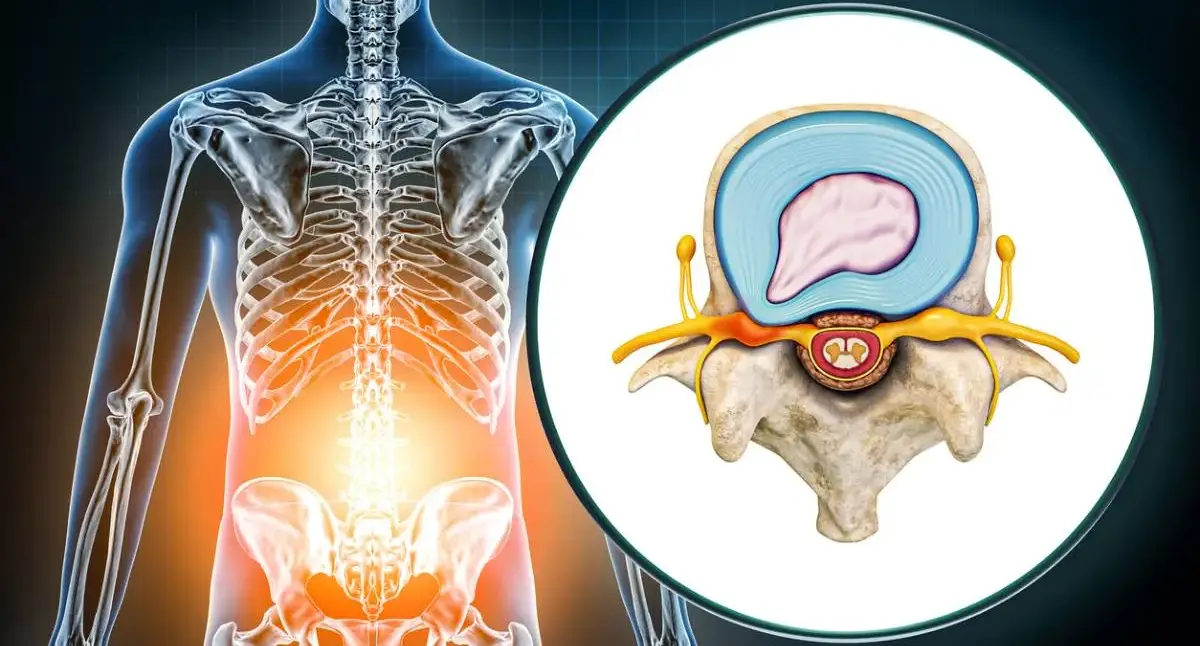





A herniated disc rarely feels “medical” when it starts. For many people it begins with a normal week: a long commute, hours at a desk, picking up a child or a heavy box, or a physically demanding job that doesn’t leave much room for perfect form. Then the pain changes—moving from a sore back to sharp pain that shoots into the leg, tingling in the foot, or an arm that goes numb when you drive.
If you’re wondering why it happened and whether you’re likely to deal with it again, understanding risk factors can be genuinely useful. Below, we walk through what a herniated disc is, which symptoms suggest a nerve is involved, and the most common factors that increase the odds of a disc injury—along with what to do next if you’re in pain.
What Is a Herniated Disc?
Your spine is a column of bones (vertebrae). Between most vertebrae sits an intervertebral disc that helps absorb shock and allows your back and neck to move. Each disc has a tougher outer layer (the annulus) and a softer, gel-like center (the nucleus).
A herniated disc happens when the softer center pushes through a tear or weak spot in the outer layer. The disc material itself isn’t always the problem—the main issue is what it does to nearby nerves. If the herniation presses on or inflames a nerve, symptoms can travel into the arm or leg depending on the level of the spine involved.
If you want a deeper overview of diagnostic and treatment options, visit our herniated disc treatment page.
Symptoms That Suggest a Herniated Disc Is Irritating a Nerve
Some people have disc herniations on MRI and feel fine. When symptoms do appear, they often reflect nerve irritation or compression rather than “disc pain” alone.
Common Symptoms Patients Notice
- Sharp, burning, or electric pain in the neck or low back
- Radiating pain down an arm/hand or buttock/leg
- Numbness or tingling in the fingers, hand, toes, or foot
- Weakness (trouble gripping, pushing off with the foot, tripping, or difficulty with stairs)
- Worse pain with certain positions, often sitting, bending, or with coughing/sneezing
When low back pain travels into the buttock and leg, many people call it “sciatica.” Not all sciatica is caused by a herniated disc, but a disc is a common reason. Learn more about evaluation and options for sciatica treatment.
Get urgent medical evaluation if you develop new loss of bowel or bladder control, numbness in the groin/saddle area, or rapidly worsening weakness. These symptoms can signal severe nerve compression and need prompt attention.
Why Herniated Discs Happen: a Plain-Language Mechanism
Discs are built for movement and load—but they’re not static structures. Over time, discs can lose hydration and elasticity, which makes them less resilient under repetitive stress. The outer layer can develop small cracks, and under the right combination of bending, lifting, twisting, or sustained sitting, the inner material can push outward.
That “right combination” is why herniated discs often show up after something that seems minor. It’s less about one dramatic moment and more about cumulative strain plus one final movement that exceeds what the disc can tolerate that day.
Disc issues may also coexist with other degenerative changes such as degenerative disc disease, which can change how force is distributed across the spine and how easily nerves become irritated.
Top Risk Factors for a Herniated Disc
Some risk factors are modifiable (how you move, how long you sit, how you lift). Others are not (genetics, age-related changes). Knowing where you fall can help you prevent recurrence and decide when an evaluation is worth it.
Prolonged Driving and Long Periods of Sitting
Long stretches of sitting—especially in a car—can put the lumbar spine in a position that increases pressure on the discs. Driving can also expose your spine to constant low-level vibration, and some people notice symptoms flare after commuting or road trips.
If pain reliably worsens with sitting and improves when standing or walking, share that pattern during your exam. It helps narrow down which structures are most likely involved.
Physically Demanding Work, Heavy Lifting, and Twisting
Work that involves repeated lifting, pulling, pushing, or twisting increases disc stress, particularly when lifting happens in tight spaces, at awkward angles, or when fatigue sets in. A classic scenario is lifting combined with rotation—turning while carrying weight—because it loads the disc unevenly.
Some people feel a sudden “pop” and immediate symptoms. Others develop pain gradually over weeks as repeated micro-injuries accumulate.
Rapid or Significant Weight Gain
Weight gain can increase the load across the lumbar spine during everyday activities like standing, walking, and bending. Weight is rarely the only factor, but it can amplify the effect of prolonged sitting and physically demanding tasks, and it can make recovery more difficult if symptoms limit movement.
Repetitive Strain and “Weekend Warrior” Activity
Sudden spikes in activity are a common story: moving furniture, heavy yard work, a new high-intensity workout, or returning to sports after a sedentary stretch. Repetitive bending, hinging, or loading can overwhelm a disc that has already become less tolerant over time.
Genetics and Family History
Some patients are predisposed to disc problems. If close family members have had early disc degeneration, recurrent herniations, or spine surgery, your discs may be more vulnerable even if you take good care of your body.
Age-Related Degeneration and Arthritis-Related Changes
Aging doesn’t automatically cause a herniation, but discs generally become less hydrated and less flexible with time. Arthritis-related changes can also reduce the “space” around nerves, so even a small herniation may create more noticeable symptoms. For patients with a broader degenerative picture, information on osteoarthritis treatment can provide helpful context.
How a Herniated Disc Is Diagnosed
Diagnosis starts with your story: where the pain travels, what triggers it, what relieves it, and whether you’ve noticed weakness or numbness. A focused exam looks at strength, sensation, reflexes, and movements that reproduce symptoms.
Imaging is not always needed right away, especially if symptoms are improving. But an MRI may be recommended when pain is persistent, severe, associated with neurologic changes, or not responding to reasonable conservative care. MRI is useful because it shows discs and nerves in detail and can help match anatomy to your symptoms.
Treatment Options Before Surgery
Most symptomatic herniated discs improve with nonsurgical treatment. The goal is to calm nerve irritation, restore movement, and build the support your spine needs so you can return to activity safely.
Common Nonsurgical Options
- Activity modification to avoid positions that flare symptoms while staying as mobile as possible
- Physical therapy focused on core strength, hip mobility, posture, and safe movement mechanics
- Medications such as anti-inflammatories or other pain-relieving options when appropriate
- Targeted injections in selected cases to reduce inflammation around an irritated nerve and create a window for rehab
Patients also commonly hear the phrase “pinched nerve” when symptoms radiate into an arm or leg. If you’re trying to connect the dots between numbness, tingling, and radiating pain, our page on pinched nerve treatment explains how these issues are evaluated.
When Surgery May Be Considered
Surgery may be discussed when pain remains limiting despite appropriate conservative treatment, or when there is significant weakness or progressive neurologic deficit. The right procedure depends on the location of the herniation and what structures are being compressed.
A common operation for disc-related nerve compression is a discectomy, which removes the portion of disc pressing on the nerve. Learn more about spinal discectomy surgery and when it’s typically considered.
When to See a Spine Specialist
Schedule an evaluation if your pain is not improving, if symptoms travel into an arm or leg, or if numbness and tingling are disrupting sleep, driving, walking, or work. It’s also worth being seen sooner if you notice weakness (for example, foot drop, frequent tripping, or loss of grip strength), or if symptoms keep recurring after rest or therapy.
An experienced specialist can help confirm whether your symptoms match a herniated disc, another condition, or a combination—and then outline the least invasive plan that makes sense for your goals.
Herniated Disc Evaluation and Treatment in Los Angeles at Yashar Neurosurgery
At Yashar Neurosurgery, Parham Yashar, MD takes a practical, patient-centered approach to herniated disc symptoms—starting with a clear explanation of what your exam and imaging do (and do not) show. Treatment plans may range from targeted nonsurgical care to advanced surgical options when needed, including approaches consistent with minimally invasive spine surgery when appropriate.
If you’re looking for the best herniated disc surgeon in Los Angeles, the most important next step is an evaluation that connects your symptoms to the correct diagnosis and lays out realistic options. To discuss radiating pain, numbness, or weakness—or to review an MRI—contact Yashar Neurosurgery in Los Angeles.