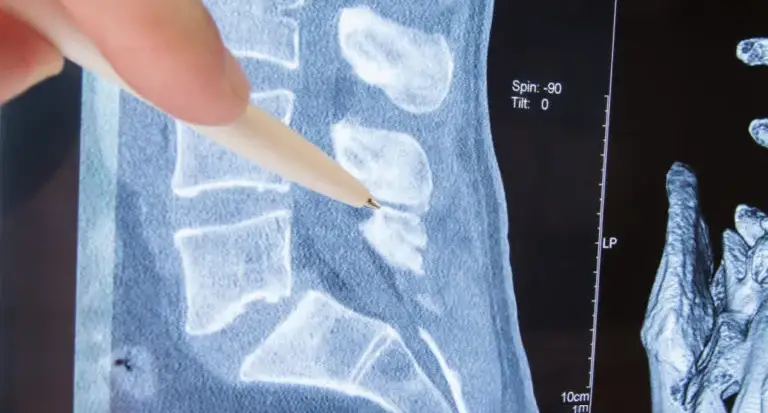





If your back or neck starts to “act up” after a few minutes of standing—waiting in line, cooking at the counter, walking from the parking lot—and you feel noticeably better once you sit down or lean forward, it can be more than simple stiffness. Many patients with spinal stenosis describe that exact pattern, then ask the same question: does spinal stenosis go away?
The most accurate answer is: the narrowing that causes stenosis usually does not disappear on its own, but the symptoms often can improve with the right diagnosis and treatment plan. Below is a clear, patient-centered guide to what spinal stenosis is, why symptoms fluctuate, and what options can help you get back to walking, sleeping, and moving with more confidence.
What Spinal Stenosis Is (and What Is Actually Narrowing)
“Stenosis” means narrowing. In spinal stenosis, the open spaces in the spine become tighter than they should be, leaving less room for the spinal cord or the nerve roots that exit the spine. When those nerves are compressed or irritated, you can feel pain, tingling, numbness, heaviness, or weakness—sometimes in the back or neck, and often traveling into an arm or leg.
Stenosis is commonly grouped by location:
- Lumbar stenosis (lower back), which tends to affect the nerve roots going into the buttocks and legs
- Cervical stenosis (neck), which can affect nerves to the arms and, in some cases, the spinal cord itself
Most stenosis is degenerative, meaning it develops gradually as the spine changes over time. Several “small” changes can stack up and reduce space for nerves, including disc bulging, thickened ligaments, and arthritis-related bony changes such as bone spurs. Many patients also have overlapping wear-and-tear diagnoses like osteoarthritis or degenerative disc disease, which can contribute to crowding in the canal or nerve openings.
Does Spinal Stenosis Go Away on Its Own?
In most cases, spinal stenosis does not “go away” in the sense that the spine naturally widens back to normal. If the narrowing is caused by degenerative changes—arthritis, thickened ligaments, disc height loss—the anatomy typically remains.
That said, your symptoms are not a direct measurement of how narrow things look on imaging. Pain can flare when nerves are inflamed and calm down when that inflammation settles. Many people get meaningful relief by:
- Reducing irritation around the nerve
- Improving strength and endurance so the spine is better supported
- Learning the positions and activities that reliably trigger symptoms
For some patients, longer-term improvement comes from addressing a specific compression point with a targeted procedure. This is why a more practical question is often: What is causing my stenosis symptoms, and what is the least invasive way to treat that cause?
Symptoms and Red Flags: When It Is More Than “Normal Back Pain”
Stenosis can start subtly—an ache after errands, a burning sensation down the leg, numbness that comes and goes—then gradually begin to limit walking, workouts, commuting, or sleep.
Common Lumbar Stenosis Symptom Pattern
A classic feature of lumbar stenosis is that symptoms often worsen with standing and walking and improve with sitting. Many patients notice they can walk farther if they’re slightly bent forward (like leaning on a shopping cart), because that posture can temporarily create more room for the nerves.
- Low back pain that may come and go
- Buttock or leg pain (sometimes more prominent than back pain)
- Tingling, numbness, cramping, or heaviness in the legs with walking
- Weakness or a feeling that your legs “give out” after being upright
Common Cervical Stenosis Symptom Pattern
Cervical stenosis may present as neck pain with arm symptoms, but it can also affect balance or hand coordination—especially if the spinal cord is involved.
- Neck pain with arm pain, tingling, or numbness
- Hand clumsiness (dropping objects, trouble buttoning, handwriting changes)
- Unsteadiness, balance problems, or a “wobbly” walk
Seek urgent medical evaluation if you develop new bladder or bowel control problems, rapidly worsening weakness, severe balance decline, or numbness in the groin/saddle area. These symptoms don’t diagnose a specific condition by themselves, but they can signal significant nerve compromise that should be assessed promptly.
Why Spinal Stenosis Can Feel Worse over Time (or Suddenly Flare)
Stenosis symptoms are often influenced by both structure and “day-to-day mechanics.” Even if the underlying narrowing changes slowly, symptoms can spike when the nerve becomes more inflamed or when your posture repeatedly places the spine in positions that tighten the already-crowded space.
Common contributors include:
- Facet joint arthritis and related bony enlargement (often tied to osteoarthritis)
- Thickening of supporting ligaments within the spinal canal
- Disc bulge or herniation (see herniated disc treatment)
- Bone spur formation (see bone spur treatment)
- Loss of disc height and stability (see degenerative disc disease treatment)
Many people feel worse with prolonged extension (standing upright, arching backward). Flexion (bending forward) can offer temporary relief, which is an important clue that the symptoms may be driven by crowding around the nerves.
Treatments That Help: a Stepwise Plan from Least to Most Invasive
The best results usually come from matching treatment to the real pain generator—your exam, your imaging, and the way symptoms behave during daily activities. For most patients, care begins conservatively and becomes more targeted only if needed.
Physical Therapy and Guided Exercise
Physical therapy does not “undo” the narrowing, but it can reduce symptoms by strengthening core and hip muscles, improving walking mechanics, and building tolerance safely. Many patients notice they can stand and walk longer when their trunk and hips provide better support and control.
Low-impact conditioning (walking intervals, stationary cycling, pool exercise) is often helpful, especially when it’s progressed in a way that avoids repeated flares.
Activity Modification That Preserves Your Lifestyle
Activity modification is not about giving up movement—it’s about changing the inputs that repeatedly irritate your nerves. This can include workstation adjustments, pacing strategies for walking, short planned breaks instead of pushing into severe symptoms, and learning which positions reliably calm symptoms.
Medications for Short-Term Control
Anti-inflammatory medications may help reduce inflammation around irritated nerves. Because these medications can have side effects and interactions (for example, with kidney disease, ulcers, or blood thinners), it’s worth reviewing your options with your physician. The goal is often to create enough symptom control to participate in rehab and daily activities—not long-term dependence.
Epidural Steroid Injections
Epidural steroid injections can reduce nerve inflammation and provide temporary relief for some patients. They do not reverse stenosis, but they can help settle a flare and make physical therapy and walking progression more tolerable.
Minimally Invasive Decompression Procedures
If symptoms persist despite appropriate conservative care—or if you have functional limitation from nerve compression (such as shrinking walking distance, progressive weakness, or persistent numbness)—your specialist may discuss procedures that create more room for the nerve. Broadly, this falls under spinal decompression.
Depending on where the nerve is pinched and what structure is causing it, a targeted option may include lumbar foraminotomy (to open the nerve passageway) or cervical laminectomy and foraminotomy (to decompress in the neck while preserving stability when appropriate). If a disc is a primary driver of nerve compression, spinal discectomy surgery may be discussed.
A careful plan should align your symptoms (where you hurt and when) with objective findings (what’s compressed and at which level). That match is one of the most important predictors of whether a procedure is likely to help.
When to See a Spine Specialist for Spinal Stenosis
It’s time to get evaluated when your world starts shrinking—shorter walks, more frequent sitting breaks, avoiding trips or exercise, or needing to plan every outing around pain. An evaluation is also appropriate if you’re stuck in a cycle of flare-ups despite reasonable self-care.
Consider prompt assessment if you notice:
- Progressive weakness in an arm or leg
- Numbness or tingling that is worsening or not settling
- Balance changes or increasing falls
- New bowel or bladder changes
These symptoms do not automatically mean surgery, but they do warrant a focused neurologic exam and a clear plan.
Spinal Stenosis Care in Los Angeles at Yashar Neurosurgery
Spinal stenosis can be exhausting because it forces constant trade-offs—how far you can walk, how long you can stand, whether you can sleep comfortably, and whether you can trust your legs or hands. At Yashar Neurosurgery, Parham Yashar, MD focuses on pinpointing what is truly driving your symptoms and building a stepwise plan that starts with appropriate conservative care and advances to minimally invasive options when that’s the best next move.
If you’re searching for the best spinal stenosis surgeon in Los Angeles for a thoughtful evaluation and clear, non-rushed guidance, schedule a consultation with Yashar Neurosurgery. Call (424) 209-2669 to reach our office in Los Angeles.