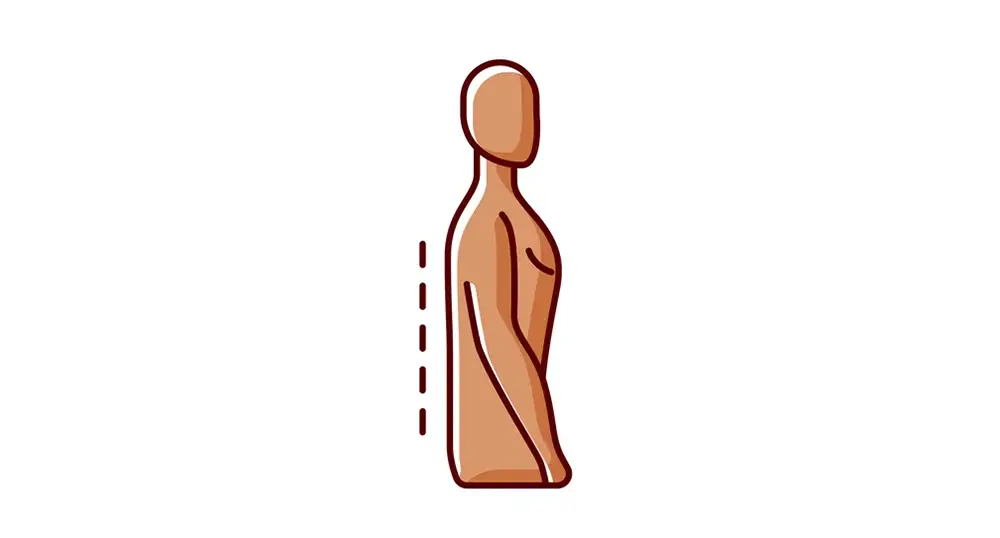





If standing at the kitchen counter makes your lower back burn within minutes, or you catch yourself bending your hips and knees just to stay balanced, you are not imagining it. For some people, that “I can’t stand up straight” feeling is caused by flatback syndrome, a type of sagittal imbalance that shifts your posture forward and makes everyday walking and standing take far more energy than they should.
Flatback syndrome can develop slowly, often alongside arthritis, bone loss, or after prior spine surgery. The good news is that a careful evaluation can usually explain why it is happening and what can be done—ranging from targeted physical therapy to, in select cases, alignment-correcting surgery. Below, we walk through what flatback syndrome is, why it develops, and when it is worth seeing a specialist.
What Is Flatback Syndrome?
Your spine is designed with gentle curves that keep your head centered over your pelvis. In the lower back (lumbar spine), that curve normally sweeps slightly inward (lordosis). Flatback syndrome happens when the lumbar curve decreases too much, making the lower back look and function “flatter” than it should.
Flatback syndrome is often discussed as part of sagittal imbalance, which describes a front-to-back alignment problem. When the lumbar curve flattens, your center of gravity shifts forward. To keep your eyes level and avoid falling forward, your body compensates—often by tightening the lower back and thigh muscles, bending the hips and knees, or leaning the upper body forward. Those compensation strategies can work for a while, but they frequently lead to fatigue, aching, and reduced walking tolerance over time.
Symptoms and Daily-Life Clues
Flatback syndrome is not only a posture issue. It is a mechanical and energy problem: the farther forward your weight shifts, the harder your muscles have to work to keep you upright.
Symptoms may include:
- Low back pain that worsens with standing or walking
- Muscle fatigue in the lower back, buttocks, or thighs (often described as “I run out of gas”)
- Forward-leaning posture with the head and shoulders drifting in front of the hips
- Difficulty standing fully upright, especially later in the day
- Chronically bent hips and knees used to maintain balance
- Reduced mobility, shorter stride, or needing more breaks when walking
Some people also have symptoms that overlap with other spinal problems—such as leg pain, numbness, tingling, or heaviness—particularly when nerve compression is present. That is one reason it helps to evaluate flatback in the context of other spine conditions, not in isolation.
How Flatback Syndrome Is Diagnosed
Diagnosis starts with understanding how your symptoms show up in real life: how far you can walk, whether you feel pulled forward, and what positions bring relief. In the exam room, a spine specialist may look at your standing posture from the side, assess hip and knee positioning, and observe how your alignment changes as you walk.
A typical evaluation may include:
- Gait assessment to see how posture, balance, and fatigue change with movement
- Spinal exam to evaluate alignment, flexibility, and painful areas
- Neurologic exam (strength, sensation, reflexes) to look for nerve involvement
- Musculoskeletal exam to check hip flexor and hamstring tightness and other compensation patterns
Imaging helps confirm the mechanics. X-rays can show overall alignment and loss of lumbar lordosis. CT or MRI may be used when your symptoms suggest disc degeneration, arthritis, prior surgical changes, or possible narrowing around nerves. If your history points toward nerve compression, your specialist may also evaluate for spinal stenosis or related causes of leg symptoms.
Why Flatback Syndrome Develops
Flatback syndrome develops when something changes the spine’s ability to maintain its natural curves and balance. Sometimes it is a gradual process driven by wear-and-tear; other times it is related to inflammatory disease, bone quality, or the lasting effects of prior surgery.
Common causes and associated conditions include:
- Prior spine surgery that reduces lumbar lordosis or alters alignment over time, including certain post-laminectomy patterns
- Older scoliosis correction with Harrington rods, which in some patients could flatten the lumbar curve
- Inflammatory arthritis such as rheumatoid arthritis
- Ankylosing spondylitis, which can stiffen the spine and progressively change posture
- Osteoporosis, especially when vertebral shape changes or fractures affect alignment
Less commonly, sagittal imbalance can be related to congenital or developmental differences in spinal shape.
Once the lumbar curve is reduced, forces through the discs and facet joints can change. Over time, those altered mechanics may speed up disc degeneration and joint irritation, creating a cycle of pain, tightness, and increasing compensation.
Non-Surgical Treatment Options
Many people with mild to moderate symptoms can improve comfort and function without surgery. Non-surgical care focuses on reducing pain and improving the muscular support that helps you stay upright with less strain.
Common options include:
- Physical therapy and guided exercise to strengthen the core and glutes, improve endurance, and retrain posture and gait mechanics
- Anti-inflammatory medications (NSAIDs) when appropriate, to reduce pain related to joint irritation and inflammation
- Epidural steroid injections in selected cases, especially when nerve irritation is contributing to leg symptoms
Stretching can also matter, particularly when tight hip flexors and hamstrings are contributing to a forward-leaning stance. The most helpful programs are individualized—based on your alignment, flexibility, and symptom triggers—rather than generic “posture exercises” pulled from the internet.
When Surgery May Be Considered
Surgery is not the first step for most patients. It may be discussed when flatback syndrome is clearly structural, symptoms are significantly limiting, or non-surgical treatment has not provided enough relief.
When surgery is appropriate, the goal is typically to improve spinal alignment and reduce the forward shift in posture. In complex cases, this can involve osteotomy-based techniques such as posterior osteotomy, pedicle subtraction osteotomy, anterior-posterior osteotomy, or vertebral column resection. The right approach depends on your anatomy, flexibility, bone quality, prior surgeries, and the degree of imbalance.
If nerve compression is also part of the problem, a decompression procedure may be considered as part of the plan. You can read more about when spinal decompression is used and what it is designed to treat.
When to See a Spine Specialist
Consider an evaluation if your forward-leaning posture is progressing, your walking tolerance is shrinking, or you are avoiding daily activities because standing upright feels difficult. It is also reasonable to be assessed sooner if you have risk factors such as prior spine surgery, inflammatory arthritis, or osteoporosis.
Seek urgent medical attention for red-flag symptoms such as new or worsening weakness, significant balance changes, numbness spreading quickly, or changes in bowel or bladder control.
Flatback Syndrome Treatment in Los Angeles at Yashar Neurosurgery
Flatback syndrome can be frustrating because it affects the basic things you rely on—standing, walking, and feeling steady in your body. At Yashar Neurosurgery, Parham Yashar, MD takes time to connect symptoms with alignment and imaging findings, so you understand what is driving your posture and fatigue and what options make sense next. When surgery is appropriate, our team offers the full spectrum of spine surgery, including modern minimally invasive spine surgery approaches designed to reduce tissue disruption when feasible.
If you are looking for a spine specialist for flatback syndrome in Los Angeles, schedule a consultation at Yashar Neurosurgery to review your symptoms, imaging, and a personalized plan to help you stand and walk with less strain.